
This page is just chronicling the research that I have worked on and is in no way all-inclusive. No details, just the big picture.
Plasma Science Studies
Despite our ability to characterize and model plasmas, the physical interactions between a plasma and its containment are still poorly understood. To gain a better understanding of the dominant phenomena we performed Raman thermometry measurements in-situ on a capacitive plasma coupled to a sample kept under vacuum in a custom reactor. Using graphene and altering gas composition we developed an in-situ method to assist in deciphering what goes on at the boundary between solid and plasma.
It is already understood that surface charging occurs, producing a region near these boundaries called the Debye sheath. However, nanoparticles synthesized or suspended in a plasma demonstrate dramatic coagulation/size-increase when exposed to discontinuous (aka. pulsed) plasma exposures. Through physical experiments and Python-based simulations we have characterized the size increase, its trends/dependencies, as well as shown the effects of nanoparticle net-charge within the system.
For more information check out:
- Interaction Between a Low-Temperature Plasma and Graphene: An in situ Raman Thermometry Study
- Controlled Growth of silicon particles via plasma pulsing
Optoelectronics
Quantum dots are quickly becoming a flexible method of light conversion from one wavelength to another, having applications ranging from television displays to bioimaging. Due to our non-toxic organic-inorganic silicon based material’s we can safely investigate both upconversion (think 2 green photons in, 1 blue photon out) and downconversion (think 1 green photon in, 2 red photons out) processes and their respective energy level stability. The silicon core is produced through RF plasma induced synthesis as a form of controlled PECVD (Plasma Enhanced Chemical Vapor Deposition) which allows for particle volume control on the scale of several atoms. This work was done as part of the NSF – LEAP HI program, where the Mangolini lab (my boss’ lab) is working with the Tang Group, the Roberts Group, and the Eaves Group. This work centers on matching a precisely sized inorganic particle to act as the base for organic molecules with synergistic bandgaps and energy levels. For more check out some of these publications:
- Gas-phase grafting for the multifunctional surface modification of silicon quantum dots
- Bidirectional triplet exciton transfer between silicon nanocrystals and perylene
- Air-Stable Silicon Nanocrystal-Based Photon Upconversion
Batteries
My efforts in battery research were focused on increasing the capacity of lithium-ion batteries (LIBs) via the use of processed silicon as the active anode material (the negative electrode in your phone battery). Currently LIBs use graphite for that purpose which is cheap and can hold a capacity of 372 mAh/g, however pure silicon can theoretically hold 4200 mAh/g (x11 increase) which is very desirable. The issue with silicon is that when/if it cycles in a battery it reduces in capacity rapidly and tends to be much more expensive than the standard graphite anode. In 2017 my labmates and I created a stable silicon based material with a capacity of 1800 mAh/g that can be produced in large quantities relatively inexpensively. As a result we patented it (US# 17434164) and are making a startup (SiLiion). For more scientific information on my battery work, check out these papers:
- Critical barriers to the large scale commercialization of silicon-containing batteries
- Silicon-Core–Carbon-Shell Nanoparticles for Lithium-Ion Batteries: Rational Comparison between Amorphous and Graphitic Carbon Coatings
Additional research working with UCR student Kim Hizon is looking at meso-structured anode materials, also focusing on scalability and cost.
During 2022 I worked on determining the difference in the Solid Electrolyte Interphase (SEI) layer that forms on anode materials. We know that this layer heavily impacts the battery stability, however we do not fully understand what anode properties impact the SEI formation and why. This work will focus on silicon and carbon and was done at the National Renewable Energy Laboratory (NREL) using their in-situ analysis equipment (Raman) through the Department of Energy’s SCGSR Fellowship that I received.
Collaborations
I have been lucky enough to work on a few collaborations with multiple groups in areas I was not expecting to. In some places I was able to take the lead, but in every collaboration I learned a lot.
High Energy Materials Collaboration
This is a fancy way of saying explosives. Nanoscale materials are very good at rapid oxidation and thus plasma synthesized nanomaterials have potential in this space. To find the extent of this we are working as part of the Material Science in Extreme Environments (MSEE) collaboration, most directly with the Zachariah Group to investigate the potential of these nanoscale solid oxidants. For more information check out:
- Tuning the reactivity and energy release rate of I2O5 based ternary thermite systems
- Silicon Nanoparticles for the Reactivity and Energetic Density Enhancement of Energetic-Biocidal Mesoparticle Composites
Mask Sanitization
The idea centers on the development of an affordable and efficient face mask decontamination system. Giorgio Nava, Carla Berrospe Rodriguez, and I designed and tested the system’s ozone output and sanitization efficacy. Working in collaboration with Troy Alva as part of Justin Chartron’s and Joshua Morgan’s groups and with Zachary Dunn as part of Professor Pin Wang’s group we tested bacterial and viral pathogen’s resiliency against ozone decontamination. This effort resulted in a patent application that is still working its way through the US/UCR patenting system, in addition to me receiving the Lung-Wen Tsai Design Award for my adapting the system into an effective ~$25 mask decontaminator. For more information check out the paper at: Efficient facemask decontamination via forced ozone convection
Kyushu University (MOF Measurement Systems)
For the first couple of months of 2023 I was fortunate enough to be sent to the Yanai Lab at the Kyushu University in southern Japan. This lab focuses on MOFs (Metal Organic Frameworks) which can be used for anything from chemical identification to optoelectronics. Because of the limited time available with the grant, I focused my efforts on text editing and building mechanical systems for testing/analyzing the materials they synthesized in lab. That wound up being:
- Reusable flat bottom NMR tube and vacuum seal to enable the Overhauser effect.
- Open-air dissolution DNP system adaption to NMR setup.
- Flow reactor for photon upconverting porous media.
- Polymer window melt/press.
Building & Helping
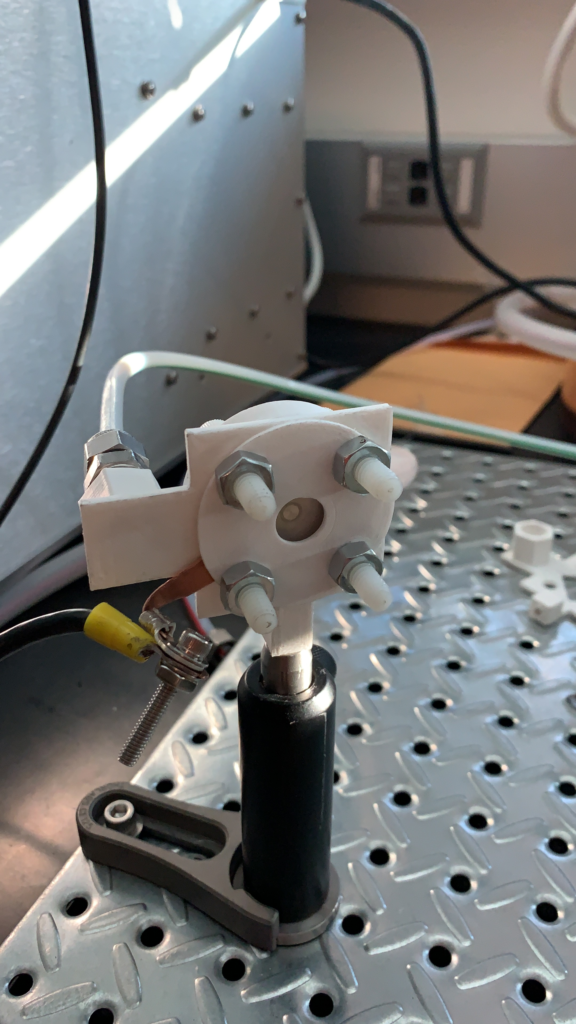
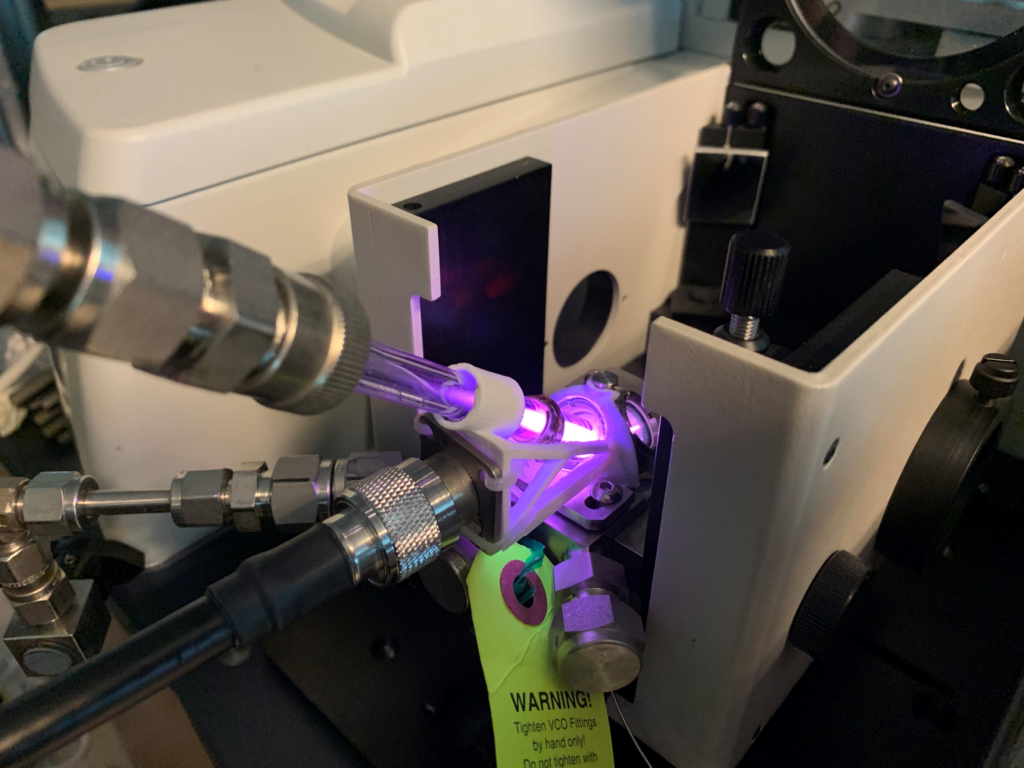
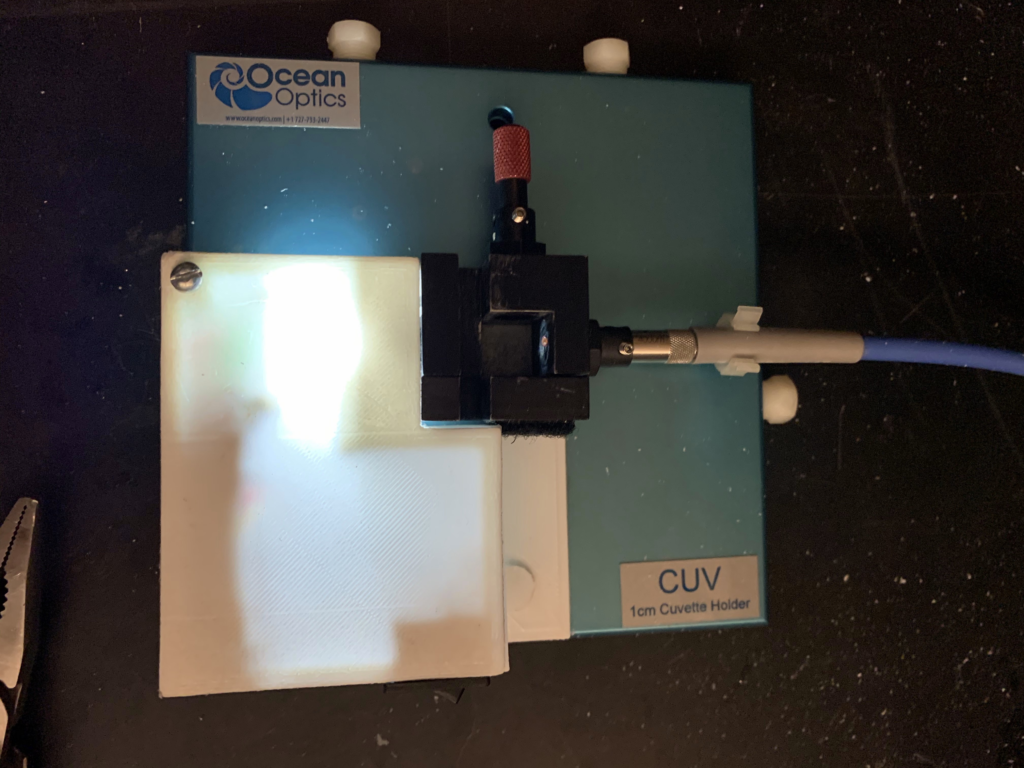
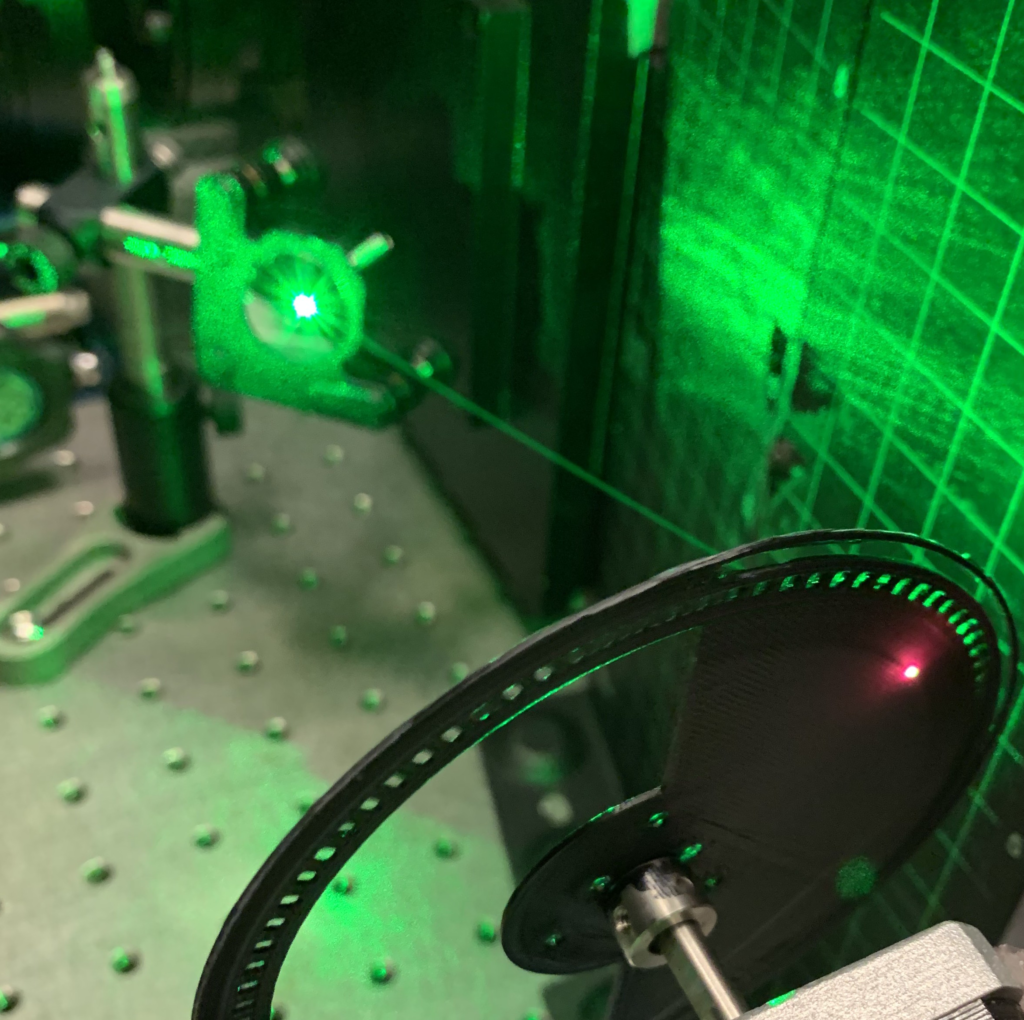
I have also made a habit of helping people out on their projects by designing and/or building their reactors via 3D printing, glassblowing, or general machining.
Older Work
Lunar Dust Lofting
During my undergraduate degrees I performed research in the IMPACT lab at the University of Colorado in Boulder. This work focused on me designing and constructing multi-geometry Langmuir probes and charge detecting devices to help understand the previously unexplained dust lofting phenomenon observed on the Moon’s surface. Using high vacuum chambers we reproduced the UV exposure, electron beam exposure and plasma conditions experienced on the lunar surface to replicate the lofting phenomenon and then analyze with the probes I built. My work on this research was featured on the Discovery Channel’s YouTube channel and has resulted in my presenting at couple of conferences as well as the following publications:
- Dust charging and transport on airless planetary bodies
- The charge state of electrostatically transported dust on regolith surfaces
- Experimental Methods of Dust Charging and Mobilization on Surfaces with Exposure to Ultraviolet Radiation or Plasmas
- Laboratory Investigation of Rate of Electrostatic Dust Lofting Over Time on Airless Planetary Bodies